
Most "live location sharing" works the obvious way: phones send coordinates to a server, the server keeps them, and everyone reads them back. It is simple, it scales, and it means the operator of that server can watch every user move in real time. For an app whose entire premise is that your routes stay yours, that was not an option.
So we built the other thing. The relay stores what it needs to route and authorise — and nothing else it could read even if it wanted to. What follows is the whole design, in enough detail to argue with.
1 · Topology
Four parties, one of which is untrusted by design
There is no socket, no push channel, and no server-side fan-out. Every client polls the same endpoint on an interval the server itself dictates, and the server keeps no connection state between calls — it is a stateless function in front of Redis.
2 · Trust boundary
What the relay can see, and what it provably cannot
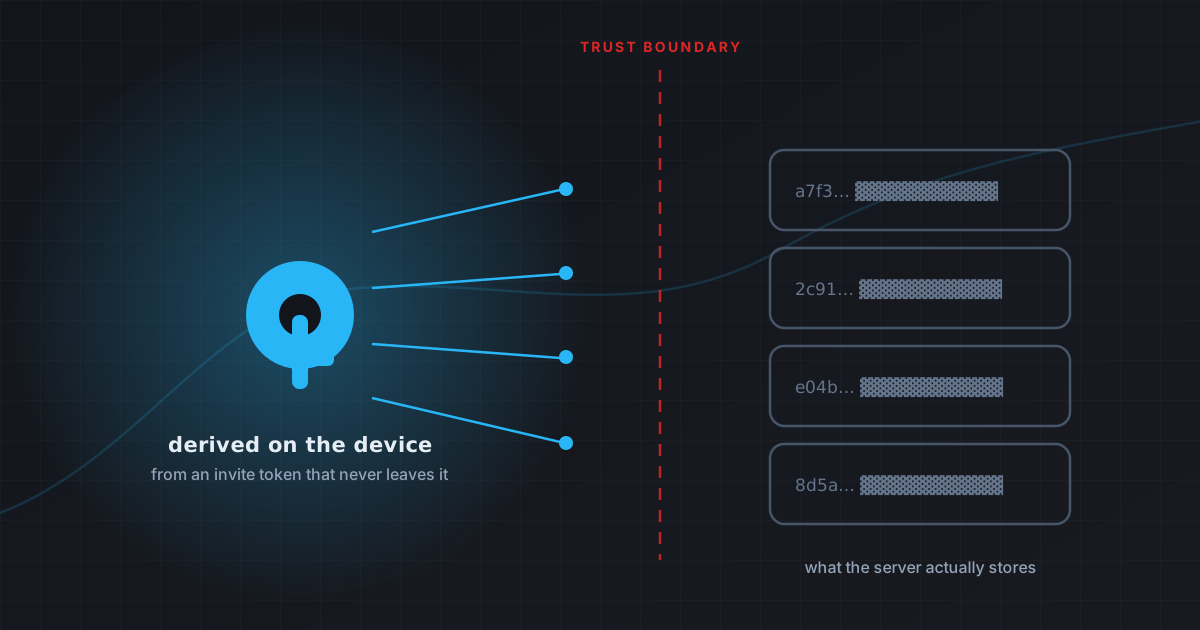
The invite token is the root secret. It is generated on the creator's device, never transmitted, and every readable field in the system is encrypted under a key derived from it. What the relay receives is a hash of that token — enough to look a group up, useless for reading anything inside it.
#, not in the path. Fragments are never sent in an HTTP request, so the token cannot appear in a server access log, a proxy, or a referrer header. Putting it in the path would have leaked the root secret of every group into logs, permanently.3 · Data model
Six key shapes, two of which are lookup indirections
A joiner arrives holding either a token or a six-character code, and neither of those is the group's identifier. Both resolve through a pointer key first. That indirection is what lets the code be short and disposable while the token stays the real secret.
Every key carries a TTL, and that is the deletion story. There is no cleanup job and no scheduled sweep. A group expires because Redis drops it — which is also why the leave path re-applies the remaining lifetime after any write: setting a value clears the expiry, and a group that quietly lost its TTL would outlive its own end date in the least visible way possible.
4 · API surface
One function, eight actions
All eight live behind a single endpoint and dispatch on the path segment. Seven verify a signed ID token and derive the caller's identity from it. One does not, deliberately.
| Action | Auth | Does | Guards |
|---|---|---|---|
create | signed in | Writes all five keys in one atomic call, returns the group id and code | Fails if the token hash or code already exists |
resolve | open | Token hash → group id; code → group id plus the wrapped token | Rate limited per hashed IP |
join | signed in | Adds the member and their sealed roster envelope | Capacity checked atomically; per-account hourly cap |
sync | signed in | Writes your position, returns everyone else's, plus the roster if yours is stale | Membership re-checked every call; write floor |
state | signed in | Moves the group between preparing, live and ended | Leader only; re-applies remaining lifetime |
leave | signed in | A member exits — or, if the caller is the leader, the group ends | Two different paths; see below |
remove | signed in | Leader removes a member | Leader only; cannot remove the leader |
meta | signed in | Replaces the sealed meta envelope: destination, start time | Leader only; envelope size capped |
leave is two operations behind one name. If the caller owns the group, the handler never runs the leave script at all — it routes to the same end-group path that state uses, and everyone is told the leader left. Any other member runs the script, which removes them and bumps the revision. Only when that leaves zero members does the script delete all six keys outright: an empty group is not a group, and waiting for the TTL would leave one sitting there for hours.
Why resolve is open. Someone tapping an invite link may not have signed in yet, and putting an account wall in front of "is this invite even real?" would be hostile. The cost is that it cannot be limited per account — so it is limited per IP instead, and the IP is stored as a hash rather than in the clear, because a rate-limit counter is not a reason to keep a log of who looked at what.
5 · Join
Two paths in, and only one of them knows a code
join is called, a single flag is all that distinguishes the two — which is exactly why that flag has to be threaded honestly. Both paths converge on one handler, and hardcoding it there quietly recorded every link-join as a code-join for a couple of releases.6 · The hot path
Sync is the only endpoint that runs in a loop
Every other action fires once. sync runs for the life of the group on every member's device, so its cost is the system's cost — and the server, not the client, decides how often it happens.
Roster transfer is revision-gated. The client sends the revision it last saw; the roster comes back only when the server's counter has moved. Positions are small and change constantly, rosters are larger and change rarely — sending both every ten seconds would spend most of the bandwidth re-sending names nobody changed. A member whose position has gone stale is dropped from the response entirely rather than drawn as a ghost.
7 · Limits
What stops it being abused
| Bound | Enforced where | Why it exists |
|---|---|---|
| Members per group | Inside the atomic join script | Two simultaneous joins cannot both pass a capacity check that runs outside the write |
| Group lifetime | Key TTL | The group's whole existence; expiry is the deletion |
| Join-code lifetime | TTL on the code key | Much shorter than the group — a six-character code is guessable, a token is not |
| Code lookups | Per hashed IP | Makes guessing codes at volume uneconomic |
| Join attempts | Per account | Caps how far a guessed code can actually get |
| Position writes | Timestamp compare in the sync script | A floor on the hot path regardless of what a client believes |
| Envelope sizes | Request validation | Bounds a blob nobody on the server can inspect |
A removed member still holds the key. They can decrypt anything they already have, and nothing can take that back — so authorisation, not cryptography, is the enforcement point. Every sync re-checks membership and refuses the moment the member is gone, which is why that check sits inside the atomic script rather than in a cached session.
8 · Why every mutation is a script
Two problems, one answer
Atomicity. Creating a group writes five keys. If the token pointer landed and the record did not, the group would be permanently unreachable while still occupying its code — and half-written state in a store with no schema is very hard to detect later. The create script writes all five or none.
Connection safety. The Redis client multiplexes a single connection, and a serverless function can serve several requests concurrently on one instance — so a transaction block from one request can interleave with commands from another. Scripting sidesteps that entire class of bug, at the cost of one round trip.
There is a smaller lesson in there too. Script arguments are asserted before every call, because the failure mode is silent: an out-of-range argument reads as nil rather than raising, so a miscount does not crash — it writes the wrong thing, quietly, and you find out much later.
The part worth stealing
None of this is exotic. It is a hash table, some expiry, and a key that never leaves the phone. The only real decision was refusing the easy version at the start — because retrofitting "the server cannot read this" onto a system that already could would have meant rebuilding all of it.
Questions, or think we got something wrong? Tell us.
Get TrackMe